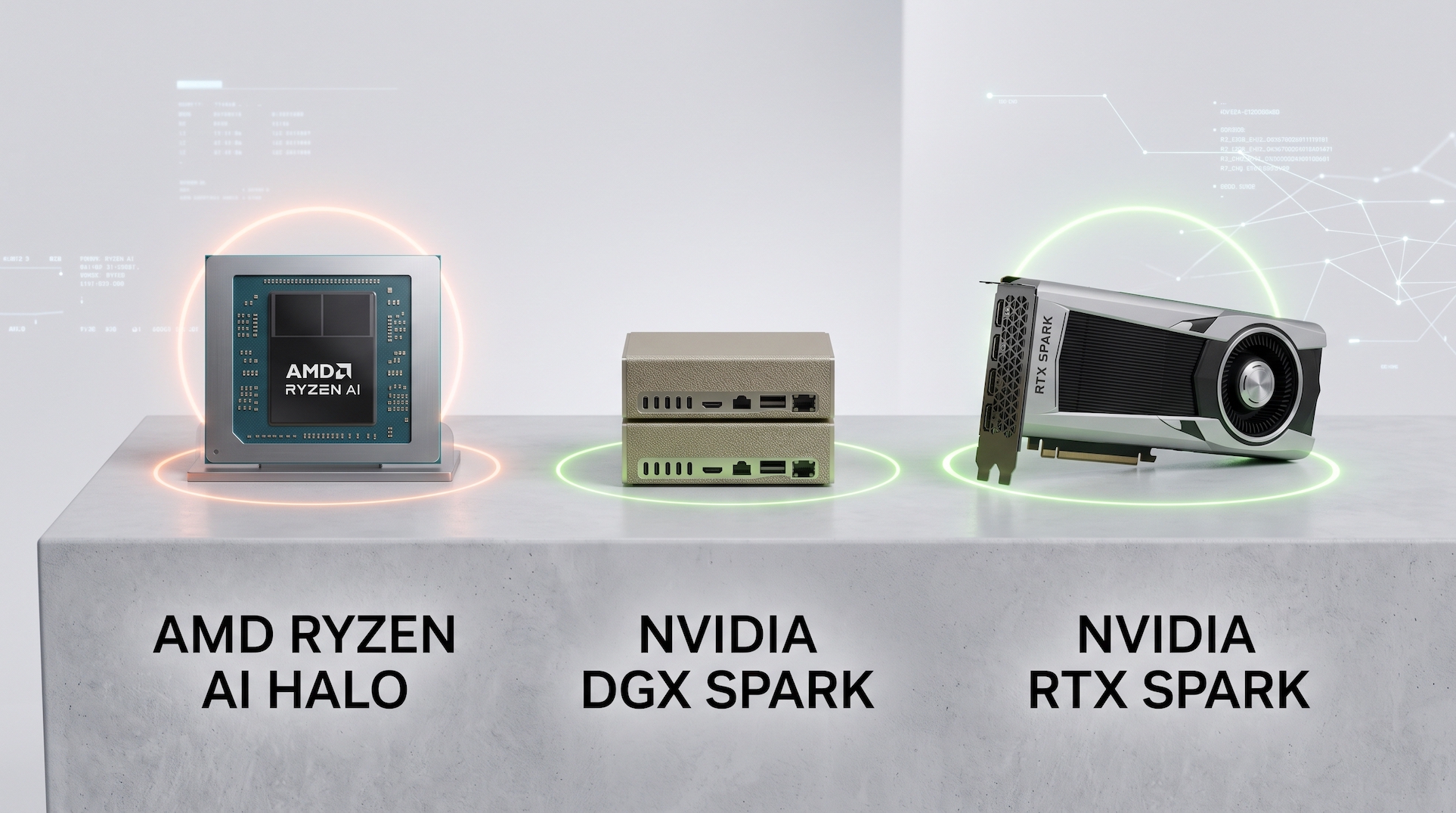
Running large AI models locally used to require a rack of servers or a pile of graphics cards. In 2026, three compact platforms are trying to change that: AMD’s Ryzen AI Halo mini PC, NVIDIA’s DGX Spark compact desktop supercomputer, and NVIDIA’s new RTX Spark superchip for AI-ready Windows laptops and compact desktops.
All three focus on large pools of unified memory so you can run big language models on your own desk, but they differ a lot in price, software, and who they are built for. This guide compares their specs, prices, release dates, and best uses.
AMD Ryzen AI Halo vs DGX Spark vs RTX Spark at a Glance
| Spec | AMD Ryzen AI Halo | NVIDIA DGX Spark | NVIDIA RTX Spark |
|---|---|---|---|
| Type | Mini PC and developer platform | Compact desktop AI supercomputer | Superchip for Windows laptops and compact desktops |
| Chip | Ryzen AI Max+ 395 (Strix Halo) | GB10 Grace Blackwell Superchip | RTX Spark (Blackwell RTX GPU plus Grace CPU) |
| CPU | 16 cores / 32 threads, up to 5.1 GHz (x86) | 20-core Arm | 20-core NVIDIA Grace (Arm) |
| GPU | Radeon 8060S, 40 compute units, up to 2.9 GHz | Blackwell-architecture GPU | Blackwell RTX GPU, 6,144 CUDA cores, 5th-gen Tensor Cores |
| Memory | 128GB unified LPDDR5X-8000 | 128GB unified LPDDR5X, 273 GB/s bandwidth | Up to 128GB unified memory |
| AI performance | 50 TOPS NPU; models up to about 200B parameters | Up to 1 petaFLOP (FP4) | Up to 1 petaFLOP (FP4); models up to about 120B parameters |
| Storage | 2TB SSD | Up to 4TB SSD | Varies by OEM |
| Operating system | Windows 11 Pro or Linux versions | NVIDIA DGX OS (Linux) | Windows |
| Size and weight | 43.2 mm tall, just over 1 kg | About 6 × 6 × 2 in, 2.6 lb | Laptops from 14 mm thick and about 3 lb, 14 to 16 in |
| Price | $3,999.99 | $4,699 list (up from $3,999 at launch); about $4,999.99 on Amazon | Set by each laptop maker |
| Release | Pre-orders June 2026, retail around July 2026 | Retail from October 15, 2025 | Announced at Computex 2026; shipping fall 2026 |
Specifications and prices come from company announcements and published coverage and may change. Pricing for these products has moved recently, so confirm current prices before buying.
AMD Ryzen AI Halo
The Ryzen AI Halo is AMD’s compact AI development platform, first shown at CES 2026. It is built around the Ryzen AI Max+ 395, an x86 processor with 16 cores and 32 threads that boosts up to 5.1 GHz, paired with integrated Radeon 8060S graphics with 40 compute units.
Key specs
- Memory: 128GB of unified LPDDR5X-8000 shared between CPU and GPU
- Storage: 2TB SSD
- NPU: 50 TOPS
- AI capacity: supports large language models up to about 200 billion parameters
- Connectivity: Wi-Fi 7, Bluetooth 5.4, 10GbE LAN, four USB-C ports (one used for power), and HDMI 2.1b
- Size: 43.2 mm tall and just over 1 kg
- Software: a Windows 11 Pro version and a Linux version
Price and availability
AMD priced it at $3,999.99 for both versions. Pre-orders started in June 2026 with retail availability expected around July 10, 2026, and early sales were reported as limited to a single US retailer, Micro Center. AMD has also said a follow-up version with the Ryzen AI Max+ PRO 495, supporting up to 192GB of memory and larger models, is expected in the third quarter of 2026.
Best for
Developers who want a compact x86 machine that can run Windows or Linux, with strong integrated graphics and a large memory pool, at a lower price than NVIDIA’s system.
NVIDIA DGX Spark
DGX Spark is NVIDIA’s desktop AI supercomputer. It was announced at CES in January 2025 with a $3,000 target price, and went on sale on October 15, 2025 at $3,999. In February 2026, NVIDIA raised the price to $4,699, citing global memory supply constraints.
Key specs
- Chip: GB10 Grace Blackwell Superchip with a 20-core Arm CPU and a Blackwell GPU
- Memory: 128GB unified LPDDR5X with 273 GB/s of bandwidth
- AI performance: up to 1 petaFLOP at FP4 precision
- Storage: up to 4TB SSD
- Size: about 6 × 6 × 2 inches and 2.6 lb, about the size of a small console
- Software: NVIDIA’s AI software stack on a Linux-based operating system
Price and availability
Its listed price is $4,699, and it was reported out of stock on NVIDIA’s store in September 2026, with Amazon listings from about $4,999.99. Prices and stock change often, so check before ordering.
Best for
AI developers and researchers who want NVIDIA’s CUDA software ecosystem on a desktop, including fine-tuning and running large models without a data center.
NVIDIA RTX Spark
RTX Spark is different: it is a chip platform, not a single product. NVIDIA announced it at Computex 2026 together with Microsoft as its first Windows system-on-chip, aimed at AI-ready laptops and compact desktops.
Key specs
- GPU: Blackwell RTX with 6,144 CUDA cores and fifth-generation Tensor Cores with FP4 support
- CPU: 20-core NVIDIA Grace, connected to the GPU over NVLink-C2C
- Memory: up to 128GB of unified memory
- AI performance: up to 1 petaFLOP; NVIDIA says it can run models up to about 120 billion parameters locally with context windows up to one million tokens
- Laptops: 14 to 16 inches, as thin as 14 mm and as light as 3 lb, with aluminum chassis and tandem OLED displays with G-SYNC
- Creator features: NVIDIA says it can render 90GB-plus 3D scenes, edit 12K 4:2:2 video, and generate 4K AI video locally
Price and availability
Laptops are expected to ship in fall 2026 from six OEM partners, and each maker will set its own prices, so there is no single RTX Spark price yet.
Best for
Creators, gamers, and developers who want one portable Windows machine for gaming, content creation, and local AI, rather than a dedicated AI box.
Head-to-Head Comparison
Price
The Ryzen AI Halo is the cheapest of the two boxes at $3,999.99, while DGX Spark lists at $4,699 and often sells for more at retail. RTX Spark pricing depends on the laptop maker.
Memory
All three top out at 128GB of unified memory, which is the main reason they can handle large models on a desktop. The Ryzen AI Halo is noted for supporting models up to about 200B parameters, similar to DGX Spark, while NVIDIA quotes about 120B for RTX Spark.
Software
NVIDIA’s products give you CUDA and NVIDIA’s AI tools. The Ryzen AI Halo uses AMD’s software stack and runs standard x86 Windows or Linux, which can be easier for general computing.
Portability
RTX Spark is the only one aimed at thin-and-light laptops. The other two are small desktop boxes.
Which One Should You Choose?
- Choose the AMD Ryzen AI Halo if you want the lowest-cost box, an x86 Windows or Linux machine, and 128GB of memory.
- Choose the NVIDIA DGX Spark if you need the NVIDIA AI software ecosystem and a dedicated desktop for developing and running models.
- Choose an RTX Spark laptop if you want a portable Windows PC for gaming, creating, and local AI in one device, and can wait for fall 2026 availability.
Frequently Asked Questions
What is the AMD Ryzen AI Halo?
A compact AI developer mini PC from AMD with a Ryzen AI Max+ 395 processor, 128GB of unified memory, and a 2TB SSD, priced at $3,999.99.
What is NVIDIA DGX Spark?
A palm-sized desktop AI supercomputer built on the GB10 Grace Blackwell Superchip with 128GB of unified memory and up to 1 petaFLOP of FP4 AI performance.
What is the NVIDIA RTX Spark superchip?
NVIDIA’s first Windows system-on-chip, announced at Computex 2026, that combines a Blackwell RTX GPU and a 20-core Grace CPU with up to 128GB of unified memory for AI-ready laptops and compact desktops.
How much does DGX Spark cost?
NVIDIA lists it at $4,699 after a February 2026 price increase from $3,999, and retail prices may be higher.
When do RTX Spark laptops come out?
NVIDIA says RTX Spark laptops will ship in fall 2026 from six OEM partners.
Can these run large language models locally?
Yes. The Ryzen AI Halo and DGX Spark are described as supporting models up to roughly 200 billion parameters, and NVIDIA says RTX Spark can run models up to about 120 billion locally. Real performance depends on the model, precision, and software.
Final Thoughts
Local AI is moving from servers to desks and laptops. AMD offers a lower-priced x86 option, NVIDIA’s DGX Spark offers a CUDA-first developer box, and RTX Spark aims to bring the same idea to thin Windows laptops. Check current prices, stock, and software support before choosing.
Prices, specifications, and availability are based on company announcements and published coverage at the time of writing, and may change. Performance claims are the manufacturers’ own. Verify details with AMD, NVIDIA, and retailers before purchasing.