


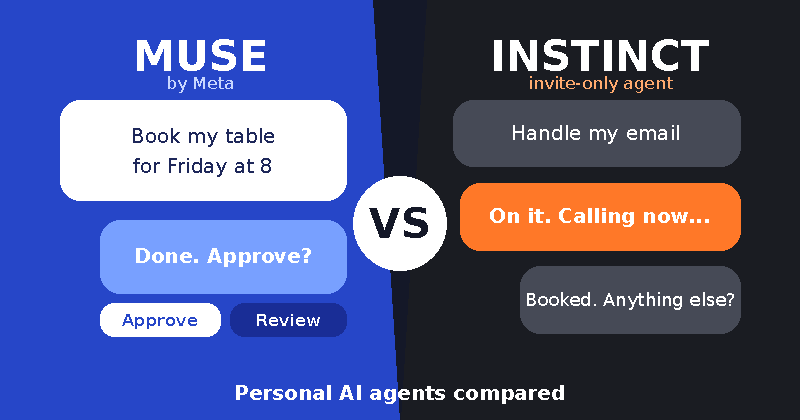
Two personal AI agents arrived within days of each other in September 2026: Meta’s Muse and the startup Instinct. Unlike chatbots that only answer questions, both are built to take actions for you, such as managing email, making calls, booking services, filling out forms, and making purchases.
They take very different routes to the same idea. Muse is a big-company app with a free tier that anyone in the US can try. Instinct is an invite-only assistant you text, backed by huge venture funding. This guide compares who owns each one, when they launched, what devices and apps they work with, how they are priced, which brands and services they connect to, and how easy and safe they are to use.
Note: both products are brand new and changing quickly. Features, prices, and availability below come from news reports and comparison articles published in September 2026. Some details differ between sources, so check each company’s own site for the latest information.
Meta Muse vs Instinct at a Glance
| Feature | Meta Muse | Instinct |
|---|---|---|
| Owner | Meta Platforms | Instinct, a San Francisco startup founded by Noah Shinn |
| Launch | September 8, 2026 (public app launch in the US) | Quiet invite-only growth since summer 2026 |
| Availability | Open to US adults (one report also says Canada) | Invite-only and waitlist |
| How you use it | Dedicated app and web, plus WhatsApp | Text it on iMessage or WhatsApp, email it, or call it |
| Supported devices | iOS, Android, web, and WhatsApp | Any phone that can use iMessage, WhatsApp, email, or calls |
| AI model | Meta’s Muse Spark model family | Undisclosed |
| Price | Free tier, with reported paid plans around $20 and $100 per month | Free in private access; no official pricing published |
| Calling | Added in September 2026 | “Instinct Concierge” calling in early access from September 16 |
| Coding | Muse Code in open beta in the US | Focused on life admin and coordination |
| Safety approach | Asks for approval before sensitive actions | Leans toward autonomy; confirmations described as a courtesy |
Figures come from news coverage and comparison articles and may change. Verify with Meta and Instinct before relying on them.
Who Owns Muse and Instinct?
Muse: Meta
Muse comes from Meta, the company behind Facebook, Instagram, WhatsApp, and Messenger. It runs on Meta’s Muse Spark model family, which Meta Superintelligence Labs introduced in April 2026 as a multimodal reasoning model built for tool use and multi-agent work. As a free app from a large platform, Muse has a built-in audience on Meta’s apps.
Instinct: Noah Shinn and Investors
Instinct is a startup led by founder Noah Shinn, a 23-year-old college dropout who was previously an early research scientist at Sierra and the lead author of the “Reflexion” AI research paper. The company has raised money at a remarkable pace, according to reports:
- A Series A of about $75 million at roughly a $500 million valuation, led by Kleiner Perkins
- A $250 million Series B at a $2.5 billion valuation, co-led by Index Ventures and Benchmark
- A reported $1 billion Series C at a $10 billion valuation in late September 2026, with backers including Sequoia, Benchmark, and Coatue
Valuation figures come from news reports and are not independently verified here.
Release Dates
- Muse Spark (model): introduced by Meta in April 2026.
- Muse (consumer app): launched in the US on September 8, 2026, adding iOS, Android, web, and WhatsApp access along with paid tiers and approval steps for purchases.
- Instinct: grew quietly through invitations over the summer of 2026, with a major funding round and calling features announced in September 2026.
- Calling features: both products added the ability to make phone calls in mid-September 2026, within days of each other.
Muse took off quickly after launch. Reports say it reached the No. 2 spot among US apps within days and topped Apple’s free app chart about ten days after launch, and one report cites roughly 730,000 downloads in five days after the calling update.
Supported Devices and Where You Use Them
Muse
Muse is available as an iOS app, an Android app, on the web, and inside WhatsApp. It is open to adults in the US, with a free tier and optional paid plans. Meta has also highlighted connections to Instagram and its other apps.
Instinct
Instinct has no traditional app. You message it by iMessage or WhatsApp, email it, or call it. That makes it work on most phones, but you need an invite or a place on the waitlist to start.
Partnerships, Integrations, and Connected Services
Muse
At launch, Meta highlighted WhatsApp, Instagram, and Stripe Link, which lets Muse handle purchases with your approval. Reviews of Muse’s connector directory also list integrations with services such as Gmail, Google Calendar, Outlook, Google Docs, Plaid, OpenTable, Spotify, Peloton, Withings, Function Health, and Tailscale, along with Meta’s own Instagram, Threads, Facebook, and Messenger. Treat this list as reported rather than official, since connectors can change.
Instinct
Instinct focuses on working through your messages, email, and phone calls. It is reported to follow up on neglected threads, make calls or send texts, and handle tasks such as arranging a ride or booking a service. It has not published a long list of branded partners, and much of how it works depends on connecting your own accounts.
Ease of Use
- Muse: easy to start if you are in the US, since you can download an app or use it in WhatsApp, with a free tier. It is designed to ask before it acts, so you stay in control.
- Instinct: very simple once you are in, because you just text it like a person. The hard part is getting access, since it is invite-only and has been described as slowing down when demand is high.
What Can Each One Do?
Muse
- Handles email, travel planning, forms, and bills in the background
- Books reservations and makes purchases through Stripe Link, with approval
- Makes calls and works with browsers on your behalf
- Offers Muse Code, which writes code, runs tests, and refactors across files (open beta in the US)
Instinct
- Works as a personal assistant over iMessage, WhatsApp, email, and phone
- Follows up on forgotten messages and coordinates tasks
- Can call or text on your behalf and arrange services
Pricing
- Muse: a free tier, with reported paid plans at about $20 and $100 per month.
- Instinct: free during private access, with no published pricing. Industry reports suggest future subscription tiers may be much higher, in the range of $200 to $500 per month, and its founder has reportedly said active users spend more than $1,300 per month on purchases through the assistant. These figures are reports, not official pricing.
Privacy and Safety: The Big Difference
Because these agents can spend money, send messages, and access accounts, how they handle permission matters.
- Muse: reportedly runs each user’s tasks in a dedicated virtual machine, with a separate safety system that gates sensitive actions behind your approval. Comparison articles say it does not see your passwords or payment methods directly.
- Instinct: reportedly asks for a high level of delegation, including login access to your accounts, and acts on your behalf with fewer visible limits. Reports also say its terms describe confirmation steps as a courtesy rather than a guarantee.
These descriptions come from third-party comparisons and company terms and may change. Before using any AI agent, read its privacy policy, limit what it can access, set spending limits, and avoid giving access to accounts you cannot afford to risk.
Muse vs Instinct: Which Should You Choose?
- Choose Muse if you want an AI agent you can actually try today, with a free tier, clear approval steps, apps on your phone, and connections to services you already use.
- Choose Instinct if you can get an invite and you like the idea of a text-message assistant that takes initiative, and you are comfortable with the trade-offs on access and control.
Frequently Asked Questions
What is Meta Muse?
Muse is Meta’s personal AI agent app, launched in the US on September 8, 2026, that can take actions such as booking, buying, calling, and filling in forms for you.
What is Instinct?
Instinct is an invite-only personal AI agent from a San Francisco startup that you reach by iMessage, WhatsApp, email, or phone.
Who owns Instinct?
The company was founded by Noah Shinn and is backed by investors including Kleiner Perkins, Index Ventures, Benchmark, Sequoia, and Coatue, according to reports.
Is Muse free?
There is a free tier, and paid plans have been reported at about $20 and $100 per month.
Is Instinct free?
It is free during private access. No official pricing has been published.
Which one is easier to get?
Muse. Instinct is invite-only, while Muse is open to adults in the US.
Can they make phone calls?
Yes. Both added calling features in mid-September 2026, although Instinct’s calling is in early access for a smaller group.
Are AI agents safe to use?
They can be useful, but they can also make mistakes. Limit their access, review actions before approving, set spending limits, and read the privacy terms.
Final Thoughts
Muse and Instinct show where consumer AI is going: from chatbots that talk to agents that act. Muse offers a more accessible and cautious experience from a major platform, while Instinct offers a more autonomous, text-based assistant that is harder to get into and more demanding on trust. Both are new, so expect changes, and think carefully about what you let an AI do for you.
This article is based on news reports and comparison articles from September 2026. Features, prices, availability, valuations, and policies change quickly and may differ between sources. Verify details with Meta and Instinct before signing up or giving any app access to your accounts. This is not financial or legal advice.